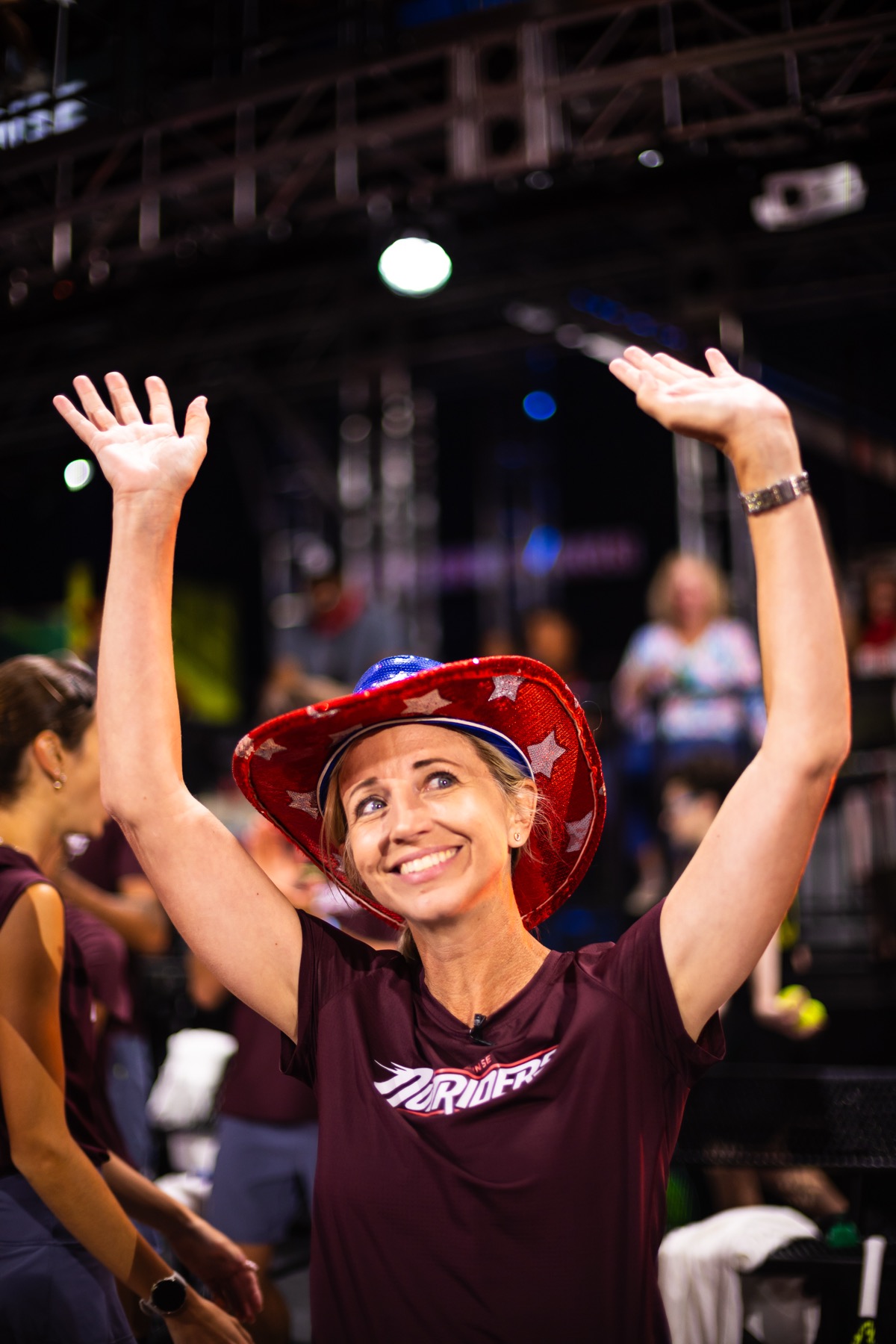
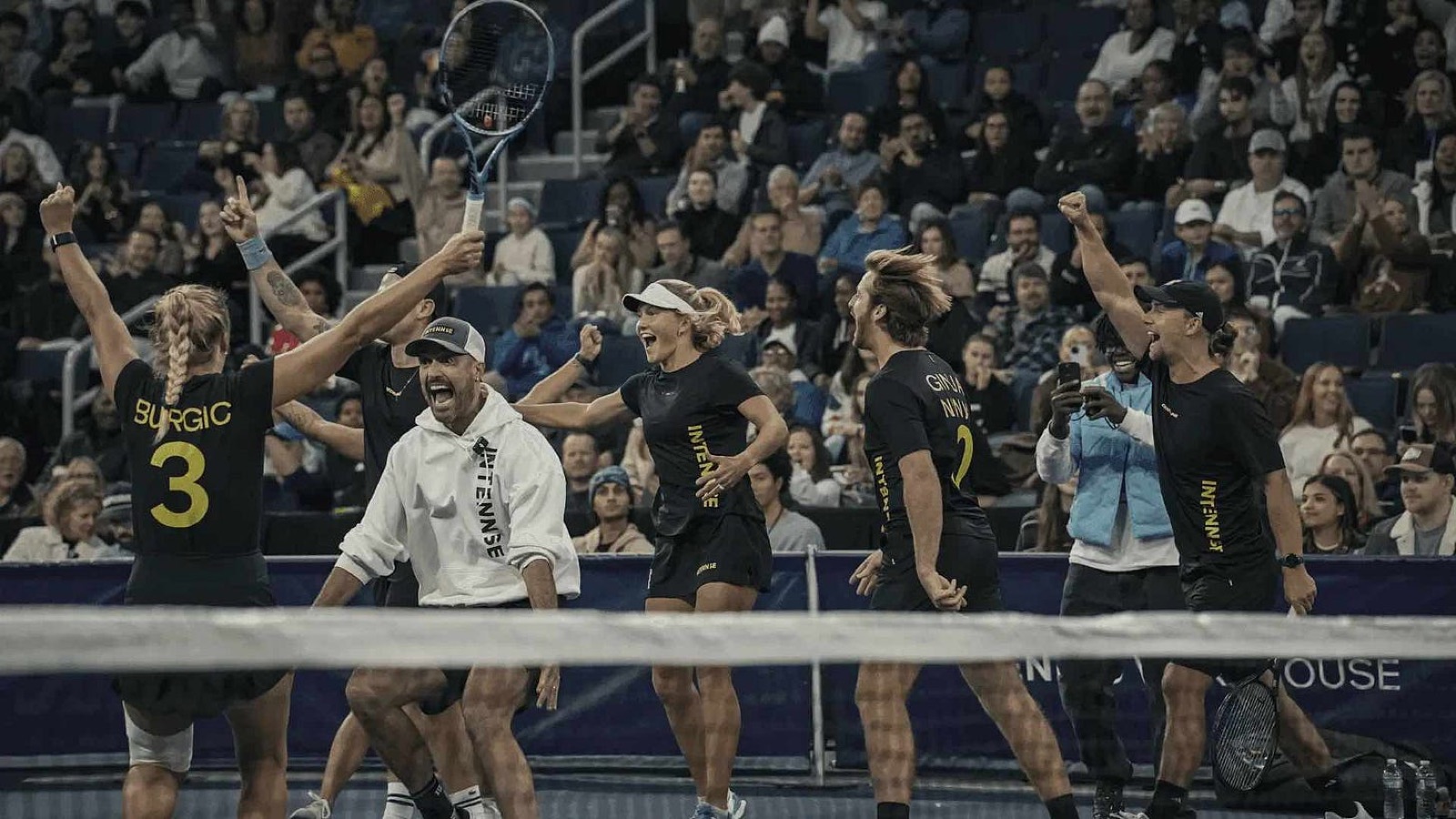
Sixty thousand adults in metro Atlanta play league tennis every week, in the suburbs, with their families, on a schedule. There is now a professional league on top of that, in your city, in a sport you have never been in.
A partnership proposal · about four minutes
“This one you can have fun.” — in the stands, Atlanta
A gender-balanced Professional Team Tennis League
Eight playing weeks in the middle of the summer. Switch the view to see the
same season against the American sports year, or against the college calendar our players come from.
INTENNSE Grand Slams Team events
INTENNSE Regular season Postseason
INTENNSE Regular season Postseason & championships
2026 season. INTENNSE: 5 June – 1 August, 58 days, one dark week for Wimbledon. Sources: data.intennse.com/2026/calendar.tsv; published tournament calendars.2026 calendar year. The NBA and NHL finished on 13 and 14 June; the NFL’s season opens 9 September; LOVB ran January to April. Only MLB is in season through INTENNSE’s eight weeks. Sources: published league calendars; INTENNSE figures from data.intennse.com.NCAA Division I, 2026 as it happened. Both the men’s and the women’s team championships finished on Sunday 17 May at the Dan Magill Tennis Complex in Athens, Georgia — Virginia over Texas, Texas A&M over Auburn. The NCAA has moved singles and doubles out of May: they are now a November event, so a graduating senior has nothing left on the college calendar at all. Basketball’s season opened in November 2025; the January football block is the 2025 season’s playoff. D-I carries 5,207 tennis players across 541 programmes. Sources: ncaa.com championship releases, official school schedules, NCAA Sports Sponsorship and Participation Rates Report 2024–25.
Where our players have been on the tour, and where they sit on the rating that
covers everyone. The orange rule is where tennis starts paying for itself.
Career high September 2026MVP race ↗ (second scale) alone = no tour ranking, placed by MVP standingName in yellow = straight from college
Rounds 1–3 of the 2026 draft, plus three players the draft board leaves out altogether and one fourth-round pick: 56 in all. Forty-seven carry an ATP or WTA career high. The nine below the dotted line in each panel have no tour ranking on record and are placed by where they finished in the league’s own MVP race — among them Sofia Cabezas, fifth in that race, and Corey Craig, thirteenth, straight out of Florida State. Two more carry a career high but no current singles ranking, so they show a career-high dot alone. Fourth-round picks are otherwise excluded — 2027 rosters are three women and three men. The one exception is John Chin, 19th of 31 men over four Arcs, ahead of eight higher picks including two first-rounders. A player placed by MVP standing needs more than one Arc behind the number: Season Score is the sum of a player’s best six rounds divided by six, so a single appearance is not a season. Ranking axis runs worst to best, left to right, as in the UTR chart below. The MVP race is a separate scale, and it stops at our own best-ranked player rather than running the width of the chart — it ranks these players against each other inside the league, not against the tour. Aliona Bolsova sits inside that line on both counts: a career high of 88, inside a Grand Slam draw, and first in the 2026 MVP race. A career high is never drawn worse than the player’s current ranking: where a recorded best is stale, the best is at least today’s rank and the two collapse to a single point. Tier cut-offs: main draw top 128 — the draw size of a Grand Slam — Challenger 129–350, ITF Futures 351–900 (the ITF renamed the Futures circuit the World Tennis Tour in 2019). The orange rule is the break-even ranking — where prize money covers the cost of competing. It is drawn at ~150, which is where a peer-reviewed 2026 study puts it once a realistic cost base including a coach is counted — and every professional has a coach. The faint rule behind it is the ITF’s own 2013 figure, 336 for men and 253 for women, which sits at a worse ranking only because those costs exclude coaching and all support-team expense. It is the bar nobody actually competes under. Against the real bar: of the 26 men here with a career high, all 26 never reached 150; of 21 women, 19 never did — the exceptions are Aliona Bolsova at 88 and Usue Arconada at 130. On today’s rankings it is unanimous: 25 of 25 ranked men and 20 of 20 ranked women sit outside break-even. Sources: draft.intennse.com, stats.intennse.com MVP race, intennse.com player pages, Tennis Abstract, retrieved 20–21 September 2026; ITF Pro Circuit Review, Stage One: Data Analysis, December 2014; Schöttl et al., Social Sciences & Humanities Open, 29 June 2026.
UTR: our players against the tour’s
INTENNSE player Straight from collegeTop three picks per team Tour band (10th–90th percentile)
Bands derived from 286 players who publish both a UTR rating and an ATP/WTA ranking, taken at the 10th–90th percentile of each tier. INTENNSE ratings: the top three men and three women per 2026 roster — 28 men and 30 women carry a rating on the league’s own draft board. Source: draft.intennse.com players board, retrieved 20 September 2026.
Down to the wire; Sudden Death
Two Arcs that finished a point apart. Each clip picks up in the closing minutes,
with the full Arc a click away.
Sudden death, level at 142
The final three minutes of Freeze v Rise, 20 June. The clock runs out with the teams tied, and the next point decides it: 143–142.
Atlanta tennis is not an elite sport. It is a suburban, weekly, family one.
The Atlanta Lawn Tennis Association was founded here in 1934 and calls
itself the largest tennis-based community organisation in the world. More than
60,000 members, run by six employees, playing in teams across the whole
metro, every week of the year.
That is a description of your customer. Working adults, in the suburbs, with
children, who organise a weeknight around a commitment and then eat afterwards. The sport
with the deepest participation in this city is the one with no professional partner attached
to it.
Metro Atlanta, a Friday night
■ What this actually is
A league at the top, and four tiers underneath it.
Three women and three men on court for every team, sharing one cumulative score,
about an hour and forty minutes. Forty-three Pro Arcs in 2026, sixty-five in 2027, every one carried
live — inside a wider season of fifty-four Arcs. But the matches are the smallest part of the footprint.
ClubYouth and adult recreational leagues at partner facilities across the
metro, on the same rules.Any day of the week
SchoolHigh-school and collegiate competition, same format.In season
JuniorEntry programmes, camps and local leagues in the team format.Year round
The Challenge SeriesOpen entry — 16 men, 16 women, anyone can enter, and
the top three of each earn a place on a team that plays a professional side that
week.Inside every event
The exhibitions and community showcases run in club
settings on any day of the week, not only on match days. A partnership here reaches into
neighbourhoods rather than sitting on a perimeter board.
■ Your Operators got there first
The name has been on junior tennis since 1957. Just never from head office.
The Palmetto Championships, presented by Chick-fil-A of
Anderson, has run in Belton, South Carolina since 1957 — a Level 5 USTA
tournament that brings three hundred of the state’s best juniors across fifty-one
courts and about a thousand matches. The same Operator presents the Hall of Fame
Classic, a girls’ high-school tournament now in its fortieth year. And in
Georgia, Chick-fil-A is a named partner of the Rome Tennis Center at Berry
College — sixty-three courts, and the USTA’s Outstanding Facility of
2025.
All of it is local, and that is the point. Independent Operators have been
backing junior and girls’ tennis for the better part of seventy years because it works
in their communities. Corporate has never followed them into it.
The community programme
The national portfolio is the Peach Bowl, the Kickoff Game and a high-school
basketball classic — all of it football or basketball, all of it autumn and winter. There is
no tennis in it, and nothing at all between February and August.
■ How you actually buy sport
The Peach Bowl is not a football sponsorship. It is a charity with a game attached.
It gives away more money than any bowl in America, it has funded childhood
cancer research at scale, and that is why it has lasted twenty-nine years. Reading it as a media
buy misreads it entirely.
So this is not an impressions number. It is a named, funded, publishable
programme: access to tennis for Atlanta children who have none — court
time, coaching, equipment, and a route through the junior and club tiers into an open series
where a player can earn a place alongside professionals in the same week.
The ball keepers are the detail worth knowing. They are not staff — the
single-ball rule and the serve clock make them part of the competition and part of a team, so
they wear the jersey. It turns a child’s first afternoon on a professional court into a
whole family’s way into the sport.
■ Content, not just signage
Chick-fil-A Play has no live sport in it.
You are commissioning original series, podcasts, games and a game show for
families, and buying none of the thing families actually watch together. A season of sixty-five
matches, with salaried athletes contracted to be there and available, is inventory for an app
that has none — and the club, school and junior tiers are a year-round supply of the kind
of story that app exists to tell.
That is a different conversation from perimeter boards, and as far as we can
tell nobody else is bringing it to you. It is also the same thing your Operators have been
funding in Belton and Rome for decades, at the scale a national brand can actually use.
■ What is open
No restaurant brand has bought anything here.
Thirteen corporate partners signed for 2026 and the category is unclaimed, which
means an exclusive rather than a negotiation against an incumbent — across the league, its
teams, its broadcast, and the club, school and junior programmes underneath them.
If it is worth a conversation, we will bring the full inventory, the community
programme costed, what each asset delivered in 2026 where we can prove it, and the shape of 2028
when teams move into their own markets.